Loading...
kathmandu
UNESCOStupaTempleMust VisitSpiritual
Swayambhunath (Monkey Temple)
An ancient religious complex nicknamed 'Monkey Temple,' where a miraculous self-arisen light once drew saints and sages.
Established
~460 CE
Entry Fee
NPR 200 for foreigners
Hours: Open 24 hours
Entry: NPR 200 for foreigners
Location: kathmandu
History & Heritage
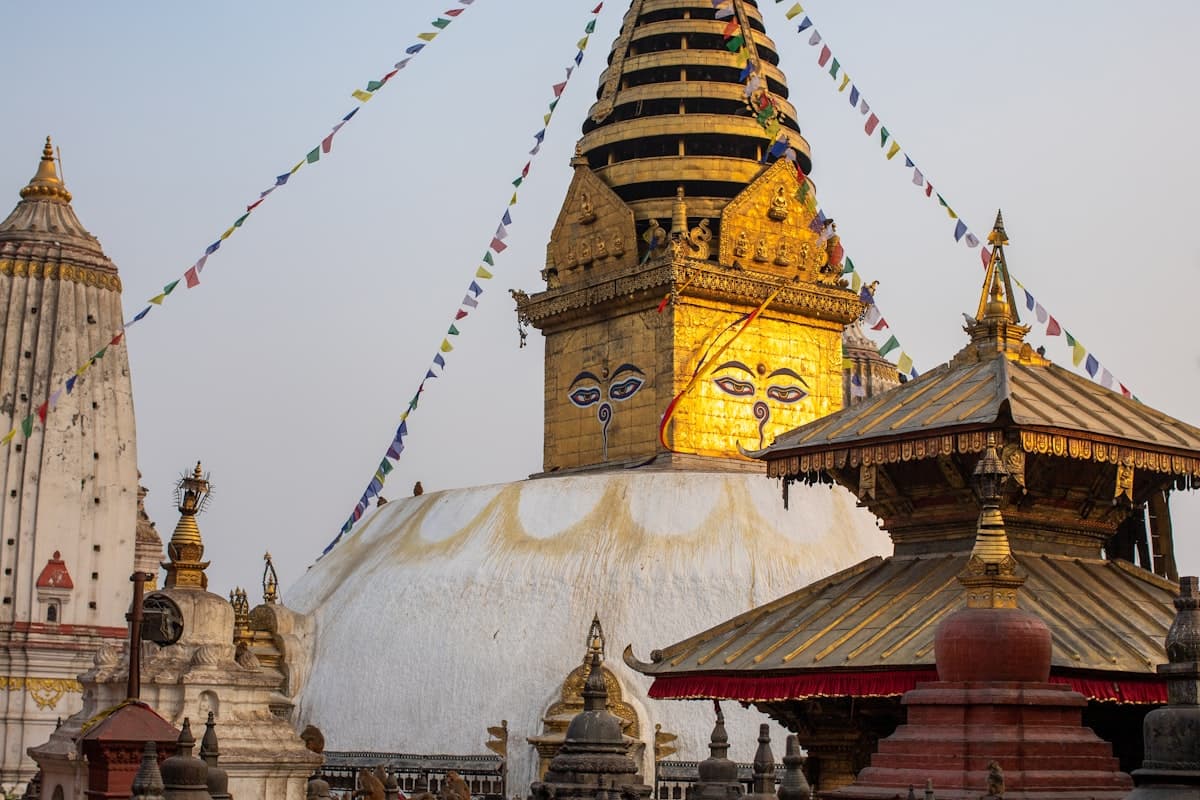
Swayambhunath is an ancient religious complex atop a hill in the Kathmandu Valley, west of Kathmandu city. The Tibetan and Sanskrit name means "self-arising" or "self-sprung," referring to a miraculous legend that has drawn pilgrims for millennia.
Historical records on a stone inscription confirm the stupa was already an important Buddhist pilgrimage destination by the 5th century AD. However, its origins predate Buddhism's arrival in the valley. The site is believed to have been established around 460 AD by King Manadeva, and by the 13th century, it had become an important center of Buddhism.
The legendary 15th-century Swayambhu Purana tells of a miraculous lotus planted by a past Buddha that blossomed from a lake once covering Kathmandu Valley. This lotus radiated brilliant light with the power to grant enlightenment, drawing saints, sages, and divinities from across the world. The bodhisattva Manjushri, determined to make it accessible, used his sword of wisdom to slice a gorge at Chobhar, draining the lake. The lotus settled on the hill where Swayambhunath now stands.
The nickname "Monkey Temple" comes from the large families of rhesus macaques inhabiting the area. According to legend, when Manjushri was raising the temple hill, the lice in his hair transformed into these monkeys, now considered sacred and believed to be transformed disciples of Manjushri.
Emperor Ashoka reportedly visited in the 3rd century BCE along with his spiritual master Upagupta Bhikku. In the 15th century, Indian Buddhist monk Śāriputra led reconstruction of the deteriorating stupa with assistance from a Malla dynasty king. King Pratap Malla built the eastern stairway in the 17th century.
The complex serves as an important pilgrimage site for both Buddhists and Hindus, with Hindu temples and deities incorporated throughout. The stupa was completely renovated in May 2010—its first major renovation since 1921—using 20 kg of gold funded by the Tibetan Nyingma Meditation Center of California.
Cultural Significance
- 1UNESCO World Heritage Site since 1979
- 2Among the oldest religious sites in Nepal
- 3Emperor Ashoka visited in 3rd century BCE
- 4Sacred to both Buddhists and Hindus
- 5Origin of Kathmandu Valley creation legend
- 6Home to sacred monkey population
Visit This Site
Include Swayambhunath (Monkey Temple) in your personalized Nepal journey. Our experts will craft the perfect itinerary.
Plan Your VisitExplore More