Loading...
kathmandu
UNESCOStupaMust VisitSpiritual
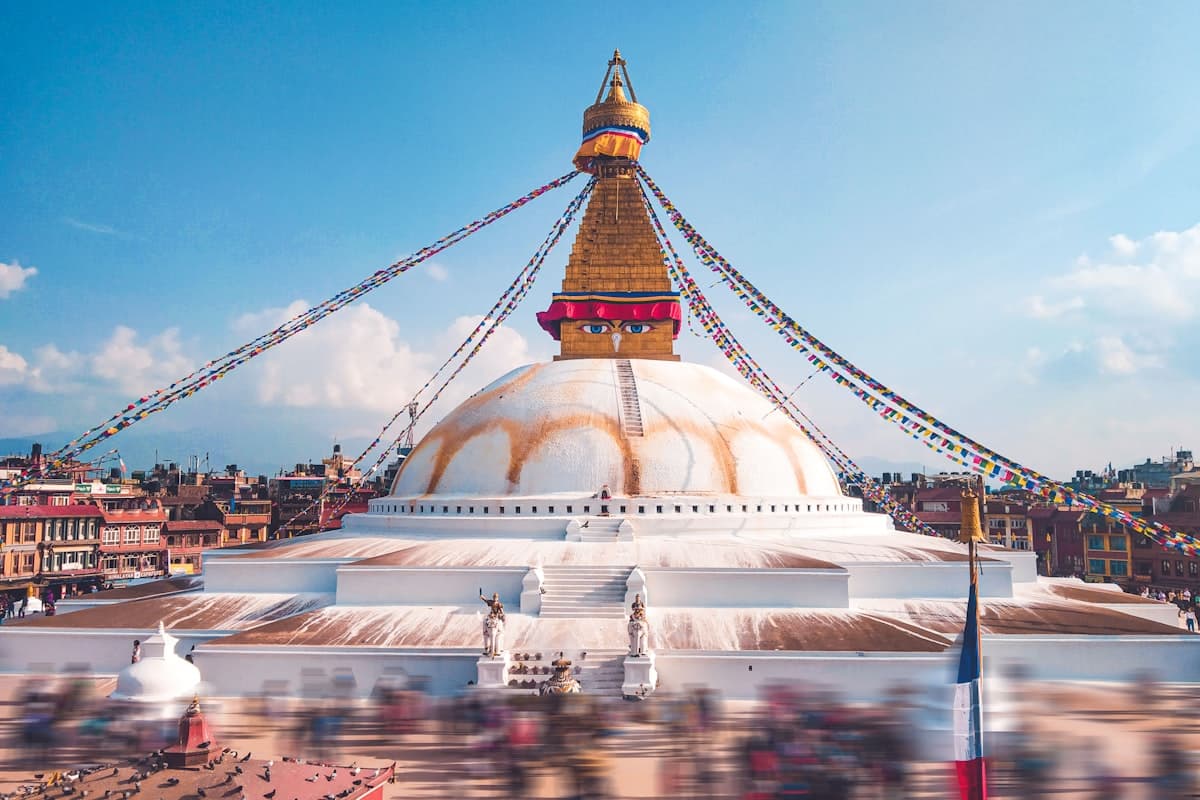
Boudhanath Stupa
One of the largest spherical stupas in the world and the most sacred Tibetan Buddhist site outside Tibet.
Established
5th century CE
Entry Fee
NPR 400 for foreigners
Hours: Open 24 hours
Entry: NPR 400 for foreigners
Location: kathmandu
History & Heritage
Boudhanath Stupa stands as a massive mandala, making it the largest spherical stupa in Nepal and one of the largest in the world. This sacred site has been a pilgrimage destination for over 1,500 years and represents the embodiment of the enlightened mind of all the Buddhas.
The Great Stupa was built in the 5th century, though precise dating remains debated. The Gopālarājavaṃśāvalī suggests it was founded by Nepali Licchavi king Śivadeva (c. 590-604 CE), while other chronicles date it to King Mānadeva's reign (464-505 CE). At the time of construction, it sat strategically on a major trade route with Tibet.
A beloved legend tells of a humble widow named Jyajima (a poultry keeper) who, with her four sons, constructed the stupa as tribute to Lord Buddha. Impressed by her devotion, the king granted her land for the construction. Today, her four sons are worshipped as the Four Great Bodhisattvas, representing principles of enlightenment and compassion.
The stupa's overall shape represents a Buddhist mandala—a cosmological map and the path toward enlightenment—as well as Mount Meru, the mythical center of the cosmos. According to Buddhist tradition, the site holds remains of Kassapa Buddha (the 27th of the named Buddhas) along with authentic bone pieces of Shakyamuni Buddha.
After the Chinese invasion of Tibet in the 1950s, a large refugee community settled around Boudhanath, bringing Tibetan religious practices, art, and traditions. Today, monasteries representing Ganden, Sakya, and Nyingma traditions surround the stupa, making it a living center of Tibetan Buddhism.
The April 2015 earthquake severely cracked the spire, requiring complete examination and restoration of everything above the dome. Funded entirely by private donations from Buddhist groups and volunteers ($2.1 million and 30 kg of gold), the stupa was reopened on November 22, 2016—the first earthquake-damaged World Heritage Site in Kathmandu Valley to be fully rebuilt.
Cultural Significance
- 1UNESCO World Heritage Site since 1979
- 2Largest spherical stupa in Nepal
- 3Most sacred Tibetan Buddhist site outside Tibet
- 4Contains relics of Kassapa and Shakyamuni Buddha
- 5Center of Tibetan Buddhist community in Nepal
- 6First heritage site restored after 2015 earthquake
Visit This Site
Include Boudhanath Stupa in your personalized Nepal journey. Our experts will craft the perfect itinerary.
Plan Your VisitExplore More